WiFi management for housing associations

In today’s world, fast Internet is part of the basic equipment of a modern living environment – in private as well as in public and business environments – like access to electricity and running water. It has assumed the status of a matter of course and is no longer regarded as a privilege or costly luxury. For residential and business customers, the providers’ products and thus the choices available to the subscriber are diverse in this respect – and usually designed for long-term customer loyalty.

Creating the basic prerequisites, such as laying network infrastructure via network or coax cabling, has long been part of the planning process when developing housing. The actual connection and management of the accesses, on the other hand, often still encounter barriers here because the products offered by providers are usually incompatible with the short terms and special ownership conditions in the housing associations’ portfolios. Simple and flexible provision of individual connections therefore often fails due to the special framework conditions.

To meet these challenges, ituma has developed a product that specifically addresses the problems in the MDU environment (Multi Dwelling Unit) and thus for housing associations and operators of short-term rental properties such as student residences, vacation or AirBnB apartments.

Providing flexible and easy-to-manage Internet access for customers/tenants is therefore a particular challenge for many operators of such properties. A broad range of solutions from providers has not yet become established, especially since the requirements for such a solution can vary greatly from property to property.

Starting from the existing network infrastructure, the already existing or planned hardware, the connection to a provider up to the individual processes that are necessary for a smooth administration and thus an interaction of the different systems, it is difficult to find a solution that works together with all these elements.

The ituma solution approach addresses the various challenges that this particular use case presents. In addition to the basic components necessary for realization, ituma also offers the corresponding flexibility and technical know-how to provide a platform that allows the operator or landlord a high degree of transparency and control and the tenant complete self-management.

Effort for the facility manager in setting up the Internet for tenants

without aduno MDU
with aduno MDU

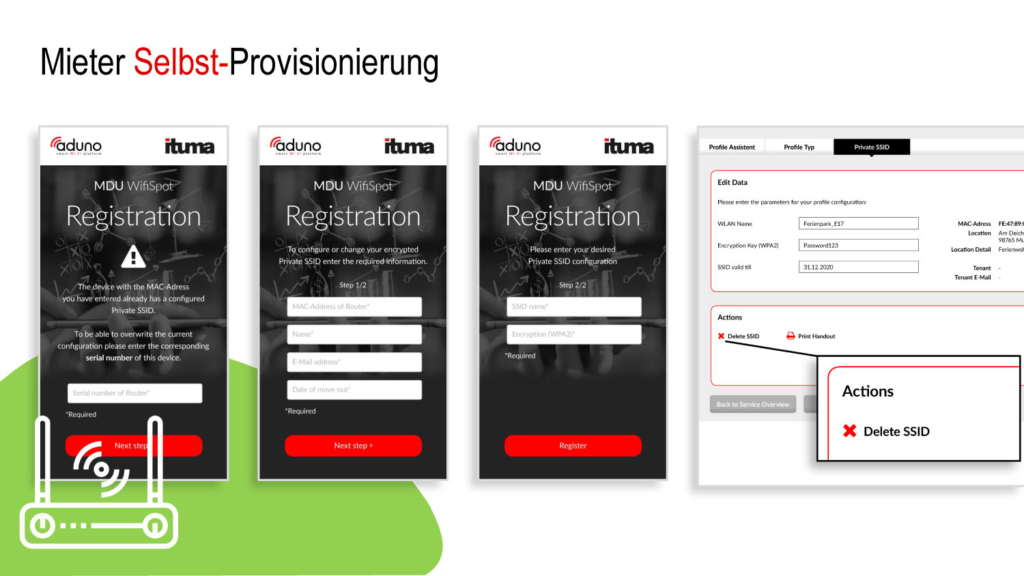
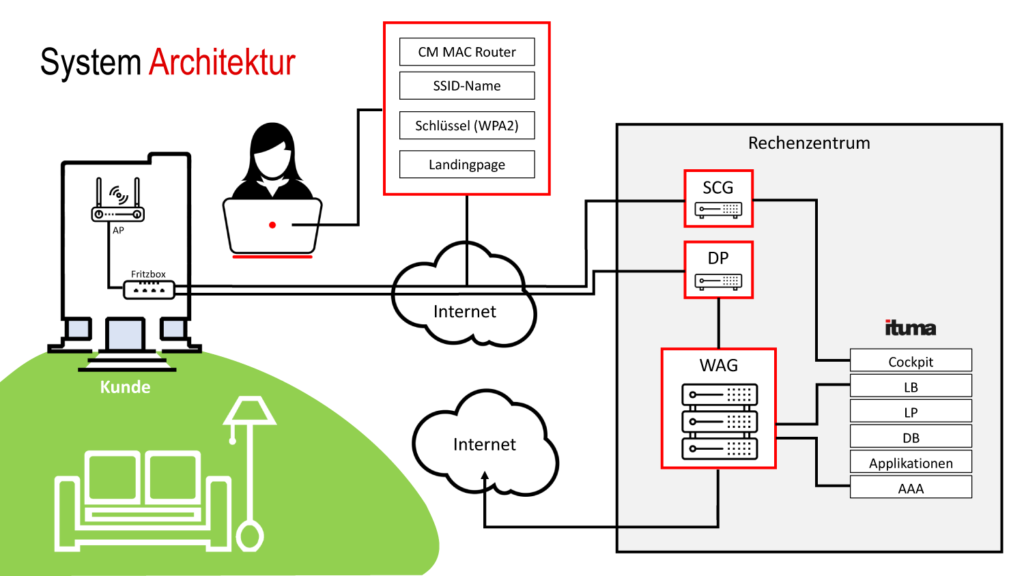
The ituma solution achieves these goals by providing a customer portal that offers the operator a central administration interface, as well as a self-administration portal for the tenant, which allows him to configure his own local WLAN in the simplest way possible.

In order to be able to serve the requirements specific to MDU properties, the ituma portal supports the operator with a broad, modular range of functions. This is constantly being further developed in order to meet future requirements. Here, ituma sees itself as a reliable partner that accompanies the customer in the long term and jointly tackles emerging challenges in the course of technical innovations.

Core elements of the portal

Device management:

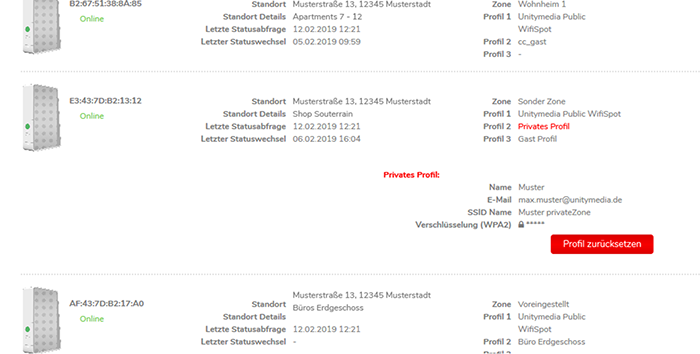
In the portal, all access points (modems and/or WLAN APs) connected by the operator in its own objects are managed centrally. Thus, the operator always has an up-to-date overview of the hardware installed at his premises. Through this device management, the operator has direct access to information such as the accessibility (online/offline), the exact location (e.g. apartment 13, 1st floor) as well as the use by the tenant (information on the WLAN set up by the tenant).

Group management:

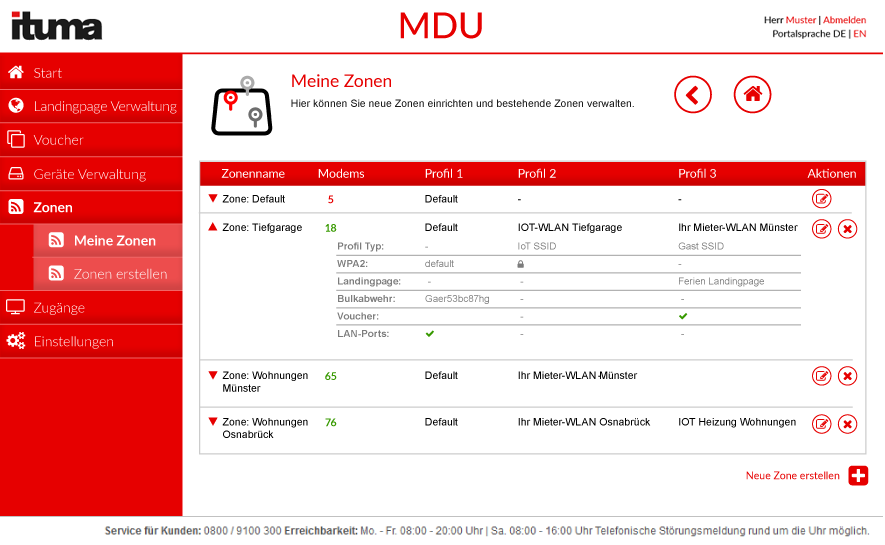
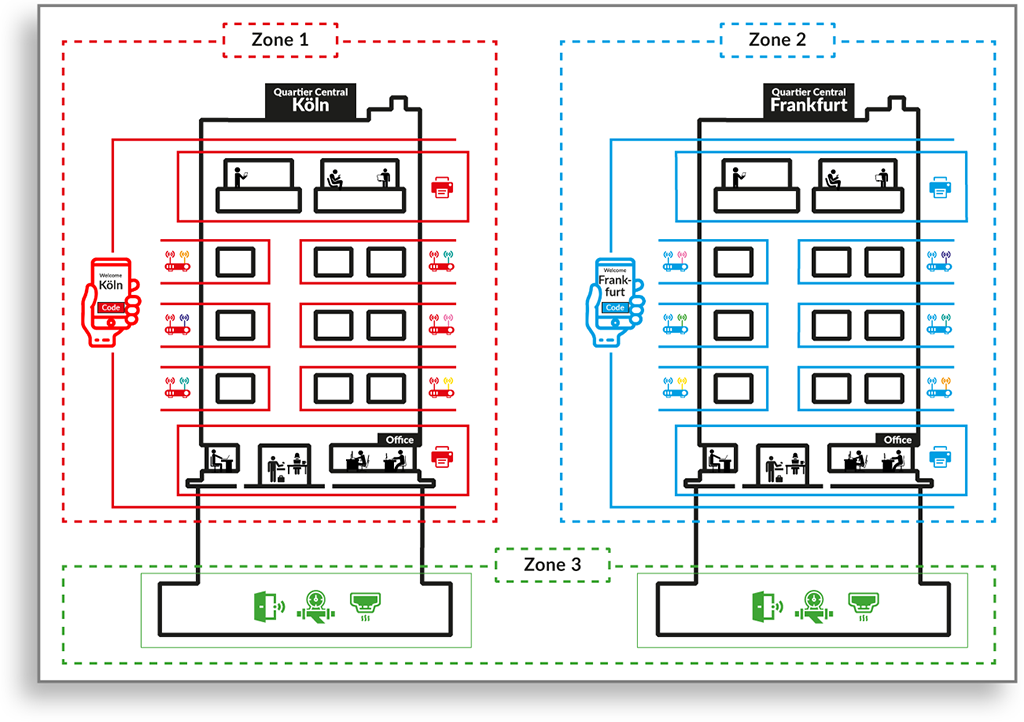
The requirements for the WLAN services that the operator wants to provide via its own hardware generally apply to multiple modems/APs. The portal therefore offers the option of grouping the hardware as the operator sees fit (e.g., by building or by deployment area) and then defining the WLAN services for all the devices contained in this group. This gives the operator the option of defining individual welcome pages for individual objects/regions when connecting to an open WLAN, for example, or of specifying independent access codes for Internet use, or of setting up independent networks for internal purposes. For example, all administrative facilities can communicate with each other on the same network, free roaming between WLANs can be enabled, or an invisible network for IOT devices can be set up. The simple menu navigation, the focus on the essential factors and the integration of all relevant systems and processes make it easy to operate centrally in one place, without the need for extended technical knowledge.

The operator receives feedback on the utilization of the infrastructure provided via a separate statistics module. This provides information about the utilization of the network connection as well as the number of users who have used the open guest WLAN, at which times the network load is greatest and whether there are different levels of utilization between the differently grouped access points. This helps in planning, in order to carry out resource planning that is both economical and in line with demand, or in fault analysis by establishing correlations between reports from tenants and problems that have occurred regionally.

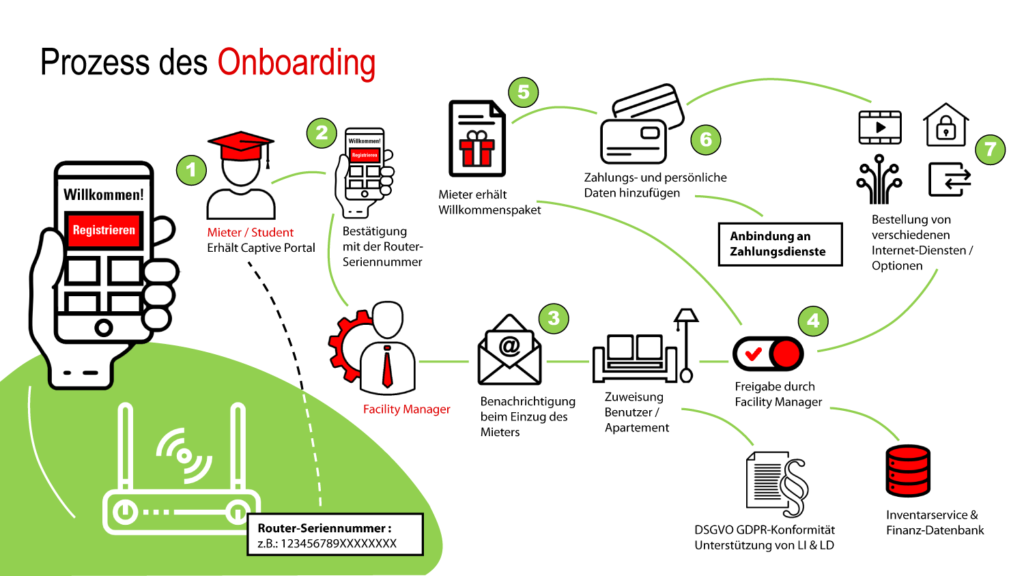
Another key aspect of the solution is to give tenants maximum self-sufficiency in configuring their own WLAN. This is not only to ensure a high degree of user-friendliness and individual room for maneuver, but above all to minimize the need for communication and support between tenant and operator. This is considerably supported by the fact that the tenant can configure his WLAN completely autonomously via his own configuration portal.

The data collected and checked as part of the setup wizard and the DSGVO-compliant processing of this data already take into account regulatory requirements. On the part of the operator, time-consuming support and administrative tasks in tenant support for the WLAN service can thus be reduced to a minimum.


  • CENTRAL ORCHESTRATION WITH AUTOMATED SELF-PROVISIONING

    Suitable for coax and ethernet connection, model can be transferred to other business cases

    • Tenant self-provision
    • Orchestration of multiple services per CPE group
    • Access to IoT devices via cockpit
    • Specific access rights for CPE groups (“caretaker account”)
    • Zone management: Grouping of profiles and properties with individual AP assignment
  • MULTIPLE LEVEL MANAGEMENT PORTAL

    Central management platform for the entire WiFi infrastructure

    • Konfigurierbare Administrations-Ebenen: z.B. für die Verwaltung der Standorte, von Gebäudegruppen einzelner Standorte oder von einzelnen Gebäuden
    • Erstellung und Verwaltung von einheitlichen Zonen, die APs aus geografisch unterschiedlichen Gebäuden enthalten
    • Steuerung der WLAN Zonen (Bandbreite, Volumen-Limit, Freischaltzeit, Zugangscodes)
    • Live-Status, Monitoring und Historie aller angebundenen Geräte
    • Analyse und Aufbereitung der anonymisierten WLAN Userdaten
    • Conten Management System
  • MANAGING OFFICE- / IOT-DEVICES

    Creation of separate WiFis for office or IoT devices

    • Configuration of individual networks in which selected devices are combined
    • Individual settings for each WLAN for assigned LAN ports, profile types and access codes
    • Free SSID allocation for all zones set up
    • Detailed information and monitoring of the captured devices in the cockpit
  • LANDINGPAGES

    Individual creation of any number of landing pages with scalable content

    • Separate landing pages for special customer / building groups
    • Uncomplicated, customer-oriented activation mechanism
    • Can be configured separately for each profile as one-click, voucher, access code or whitelisting
    • Free SSID assignment for each configured network
    • Web-based, location-independent management and changing of content